


How Often Should I Clean the Outdoor Condenser Coil
Quick answer: how often to clean the outdoor condenser coil
For most homes and businesses in Southern California, plan to visually check the outdoor AC condenser coil monthly during the cooling season, gently rinse it every 1–2 months, and schedule a thorough professional cleaning at least once a year. In coastal, dusty, high‑pollen, or wildfire‑affected areas, a deep clean twice per year is often the smarter choice to protect efficiency and equipment life.
A clean coil helps maintain airflow, keeps head pressure down, lowers energy bills, and reduces the chance of mid‑season breakdowns. Neglected coils can add 10–20% or more to energy use and shorten compressor life.
Why coils get dirty in Southern California
Outdoor condensers work like a radiator, shedding heat to the outside air. Anything that blocks fin surface or airflow hurts performance. In our region, these common factors load coils fast:
- Coastal salt mist that crystallizes on fins, especially near beaches
- Dust from dry seasons and landscaping work
- Pollen bursts in spring and early summer
- Urban pollution and road grime
- Wildfire ash and soot during and after fire events
- Leaves, grass clippings, and fluff from trees and shrubs
Los Angeles County and nearby areas including Orange County, Ventura County, and Western Riverside County can see several of these at once, which is why proactive cleaning pays off.
What homeowners can safely do
- Power off first. Use the outdoor disconnect or breaker to shut the condenser down before any cleaning.
- Clear around the unit. Keep 2–3 feet of open space on all sides and 5 feet above. Trim plants and remove leaves.
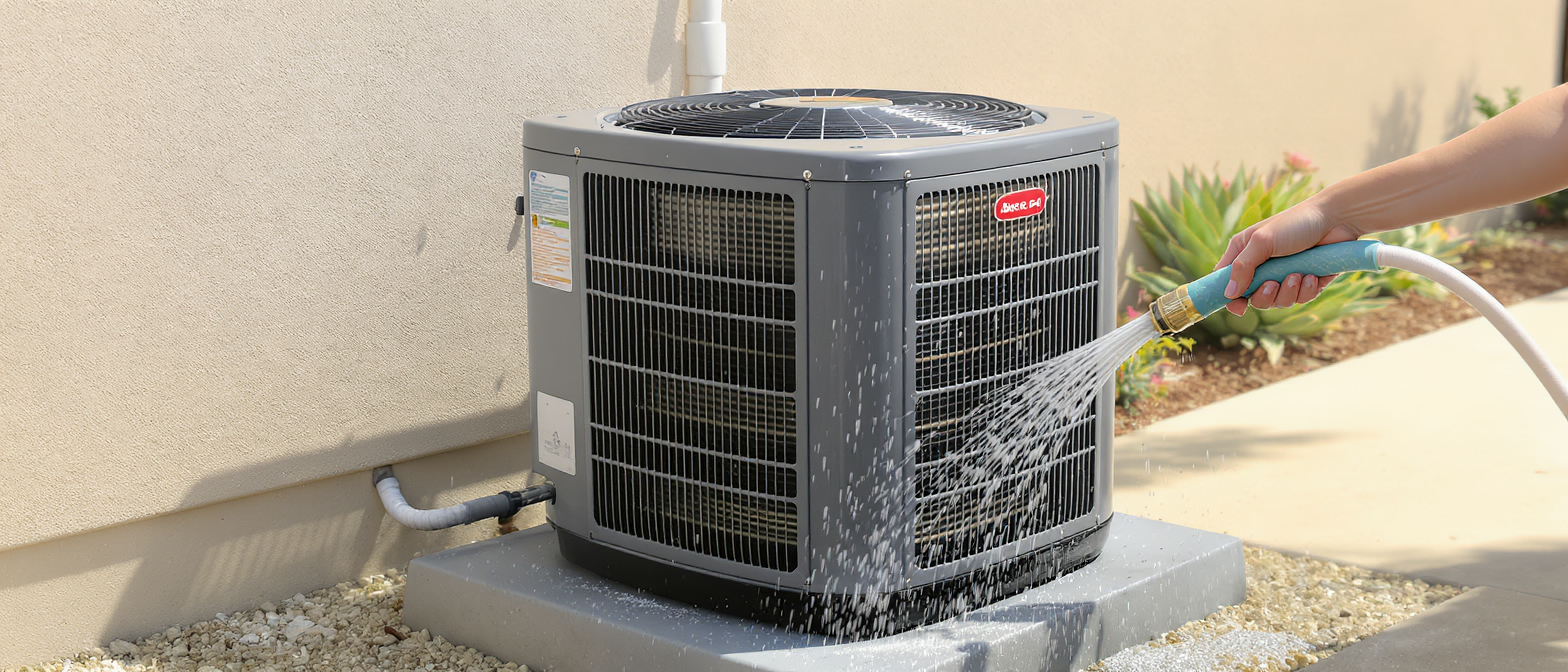
- Gentle rinse only. Use a garden hose with low pressure to rinse the coil fins. Avoid pressure washers, nozzle jets, and harsh chemicals that can bend fins or drive water into electrical components.
- Rinse direction. If you can safely access the coil from inside the cabinet (after removing the fan top, which can be heavy), rinse from the inside outward to push debris out. If not, use a gentle outside‑in rinse and stop if water pools inside the base.
- Mind electrical panels. Do not spray directly at control boxes or wiring.
- Keep the pad level. A level condenser reduces vibration and helps oil return inside the compressor.
Avoid acid or caustic coil cleaners unless you are trained and equipped. Improper chemicals can strip protective coatings, accelerate corrosion, and may void warranties.
When it is time for a professional cleaning
Some situations call for more than a quick hose rinse. Consider professional maintenance when you see:
- Dense matting of dirt, cottonwood, or pet hair on fins
- Sticky grime, grease, or white salt crust that does not rinse off
- Noticeable fin damage, crushed areas, or corrosion
- Reduced cooling, longer run times, or frequent short cycling
- Breaker trips, unusual noises, or hot refrigerant lines
Beyond effective cleaning, licensed HVAC technicians can measure superheat and subcooling, verify airflow, test capacitors and contactors, and ensure refrigerant circuits are healthy. Many equipment warranties and property insurance policies expect documented maintenance by qualified personnel; DIY chemical cleaning or disassembly can cause damage and complicate claims. In some cases, local codes and EPA rules apply when servicing sealed systems, which is why routine coil care is safest in professional hands.
Recommended schedule for our climate
- Spring startup: Full system check and deep coil cleaning before the first heat wave.
- Mid‑summer: Light rinse if dust, pollen, or coastal salt are visible on the fins.
- After events: Extra cleaning after Santa Ana winds, wildfire smoke, heavy landscaping, or storms.
- Fall check (for heat pumps or year‑round use): Verify coil is clear and the unit drains properly.
Commercial sites, kitchens, salons, workshops, and buildings near freeways or the shoreline typically need more frequent cleanings due to grease aerosols, lint, salt, and higher operating hours.
Signs the condenser coil needs cleaning now
- Higher energy bills without a change in thermostat settings
- Supply air feels warmer than usual or rooms take longer to cool
- Outdoor unit is unusually hot to the touch or louder than normal
- Fan is running but the top air feels weak or inconsistent
- Ice forming on refrigerant lines or the indoor coil
These symptoms can also indicate low airflow indoors, failed capacitors, or refrigerant problems. Proper diagnosis avoids repeat failures and protects the compressor.
Why clean coils matter for performance and lifespan
Dirty condenser fins restrict heat rejection. The compressor must work harder and longer, raising discharge pressure and current draw. That can mean:
- 5–30% capacity loss and uneven comfort
- 10–20% higher energy consumption in peak weather
- Premature wear on compressors and fan motors
- More nuisance trips and emergency calls during heat waves
Routine coil cleaning is a small step that delivers outsized gains in reliability, comfort, and operating cost.
About our expertise and mission
#1 AC Guys is a fourth‑generation family of engineers with 80+ years of engineering experience. Our mission is healthy air at home for a healthy life. We specialize in residential and commercial systems, including large and complex projects. Our engineers received manufacturer training at the factories of Fujitsu (Japan), Mitsubishi Electric (Thailand), Midea (China), Gree (China), and Haier (China).
Service area
We serve Los Angeles County and nearby areas including Orange County, Ventura County, and Western Riverside County. This includes communities such as Los Angeles, Long Beach, Pasadena, Glendale, Burbank, Santa Monica, Anaheim, Irvine, Santa Ana, Costa Mesa, Huntington Beach, Newport Beach, Oxnard, Ventura, Thousand Oaks, Riverside, Corona, Temecula, and surrounding neighborhoods.
Bottom line
Check monthly, rinse lightly every 1–2 months in season, and schedule at least one professional condenser coil cleaning per year—twice per year in harsher coastal, dusty, or wildfire conditions. When in doubt, a qualified technician can clean the coil correctly, document maintenance for warranty and insurance purposes, and confirm the system is operating safely and efficiently.
Yasmine is currently an Associate Professor of Psychology at Mount Saint Mary College where she teaches a wide array of courses in the Psychology department. She is a Fulbright Scholar spent a year working at the Medical Decision Making Center at Ono Academic College in Israel.
Yet, as many higher education professionals can surely attest to, I have also witnessed the other challenge in group decision making. In academia, engaging in critical dissent is encouraged (reviewed by Jetten & Hornsey, 2014), and while this is a fine attribute, practically,

