


Can Solar Panels Power My Air Conditioner
Short answer
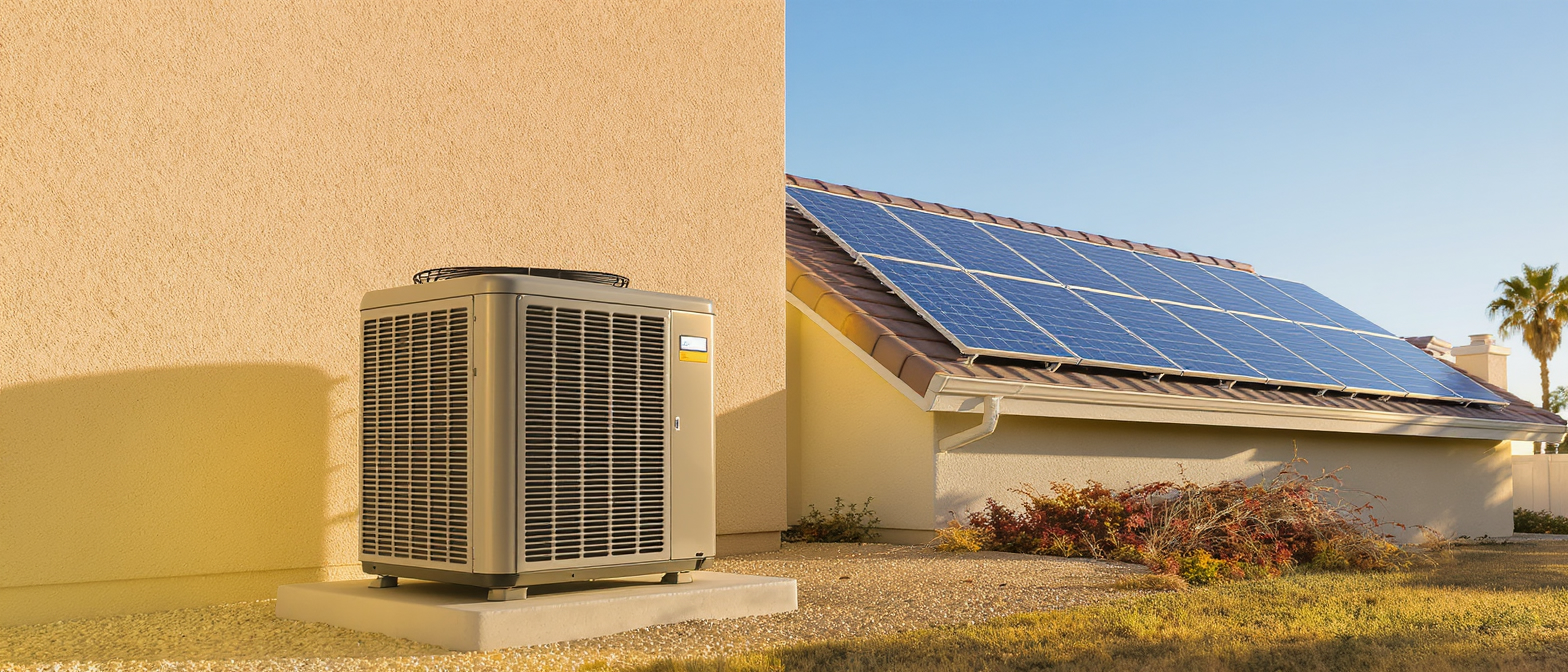
Yes—solar panels can power an air conditioner. The real outcome depends on AC efficiency (SEER2/EER2), system size in tons and BTU, your climate and roof, shading, and whether you rely on net metering or add battery storage for evening cooling.
How much power does an AC actually use?
Air conditioners vary widely. In Southern California’s climate, typical real-world draw looks like this:
- 1-ton inverter mini-split: about 600–900 W while cooling, higher for short spikes
- 2-ton ducted heat pump: roughly 1.2–2.0 kW
- 3–5 ton central AC: about 2.5–6 kW depending on SEER2 and duct losses
- Commercial rooftop unit (RTU) 5–20 tons: 5–25+ kW, often with variable-speed drives
Newer inverter systems and high SEER2 heat pumps ramp to match the load, avoiding large inrush current. That makes them friendlier to PV and battery systems than old single-stage units.
How many solar panels would it take?
Modern residential panels are ~400 W nameplate. In strong sun, continuous output is commonly 300–350 W per panel after real-world losses. Rule-of-thumb examples:
- 1-ton mini-split at 800 W: 3 panels can offset it at midday; 4–5 panels provide headroom.
- 3-ton central AC at ~3.5–4.0 kW: 12–16 panels could cover daytime operation in clear sun.
- 5-ton system at ~5–6 kW: 18–22 panels for midday coverage; more if you want margin.
But cooling is an energy problem (kWh), not just power (kW). If a 3-ton system averages 3.5 kW for 7 hours, that’s ~24.5 kWh per day. A 6 kW PV array in Los Angeles County might produce ~24–30 kWh on a good summer day. That can offset most or all of daily cooling energy, even if some is produced at different times than the load.
Direct solar vs. grid-tied, net metering, and batteries
Most homes use grid-tied PV with an inverter (UL 1741, NEC 705 interconnection) and, optionally, battery storage. Under California’s NEM 3.0, daytime exports earn lower credits, so self-consumption and battery charging often deliver better economics. A 10–15 kWh battery can shift solar energy to evening hours when AC is still needed. If you want the AC to run during outages, you’ll need an islanding-capable inverter, battery storage, proper transfer equipment, and careful load management.
Heat pumps, mini-splits, and inverter AC pair well with PV
Variable-speed systems shine with solar. High-SEER2 inverter mini-splits and heat pumps from manufacturers like Fujitsu (Japan), Mitsubishi Elektrik (Thailand), Midea (China), Gree (China), and Hier (China) modulate capacity and reduce peaks, improving comfort and stretching every kWh your array produces. Zoning helps target cooling only where needed, which lowers peak demand and panel count.
Whole-home and commercial considerations
For whole-home cooling, look beyond nameplate tonnage. Duct design, envelope upgrades, and smart thermostats can reduce run-time and system size. Commercial sites should evaluate demand charges, RTU controls, economizers, building automation, and possible DOAS integration. California Title 24 compliance and CEC-qualified equipment matter for both performance and permitting.
Roof, electrical, and code requirements
Safe solar-and-AC integration is not a DIY wiring project. Expect:
- Structural checks for panel loads and roof condition
- Fire setbacks, rapid shutdown (NEC 690.12), labeling, and proper disconnects
- NEC Article 705 interconnection methods and fault-current coordination
- AHJ permits, utility interconnection approval, and inspection
Attempting high-voltage work or modifying service equipment without qualifications is dangerous. Many insurance carriers, utilities, and manufacturers require licensed, qualified specialists for design and installation. Cutting corners can void warranties and coverage.
Basic sizing math you can sanity-check
- Estimate cooling load: nameplate tons × 12,000 BTU/h. Consider SEER2 and actual duty cycle.
- Convert to power: a modern 3-ton inverter might average ~3.5 kW in peak hours.
- Estimate daily kWh: power × cooling hours (e.g., 3.5 kW × 7 h = 24.5 kWh).
- Estimate PV output: array kW × sun-hours × derate (e.g., 6 kW × 5 h × 0.8 ≈ 24 kWh).
- Add margin for cloudy days, heat waves, and evening use. Batteries help bridge timing gaps.
Indoor air quality still matters
Efficient cooling should come with healthy air. Filtration (MERV 13 where duct static allows), clean coils, sealed ductwork, and balanced ventilation help keep fine particles and humidity in check. Our core mission is healthy air at home for a healthy life, so we view PV-plus-heat-pump upgrades as a chance to improve IAQ, not just lower bills.
When solar AC may not be the best fit
- Significant shading, limited roof area, or an aging roof near replacement
- Very mild cooling loads where payback is long
- Renters or HOA constraints on roof modifications
In these cases, efficiency upgrades (duct sealing, variable-speed equipment, smart controls) can reduce peak demand so a smaller PV system still makes sense.
Service area and who we are
#1 AC Guys is a family-owned HVAC company in Southern California with 80+ years of engineering experience across four generations. Our engineers have trained at the factory level with Fujitsu (Japan), Mitsubishi Elektrik (Thailand), Midea (China), Gree (China), and Hier (China). We specialize in residential and commercial HVAC, including big and complex projects. We serve Los Angeles County and nearby areas, including Orange County, Ventura County, and Western Riverside County. Cities we commonly work in include Los Angeles, Long Beach, Pasadena, Santa Monica, Glendale, Burbank, Anaheim, Irvine, Santa Ana, Oxnard, Thousand Oaks, Ventura, Riverside, Corona, and Temecula.
Quick answers
- Can solar fully run my AC? Yes, often for daytime loads; batteries cover evening.
- How many panels do I need? Roughly 3–5 for a 1-ton mini-split; 12–22 for 3–5 tons, depending on efficiency.
- Do I need permits? Yes—AHJ permits, utility interconnection, and code compliance are required.
- Will my insurer care? Frequently yes; many insurers require licensed, inspected work to maintain coverage.
- What improves results most? High-SEER2 inverter heat pumps, right-sized ductwork, smart controls, and sensible PV-battery sizing.
Yasmine is currently an Associate Professor of Psychology at Mount Saint Mary College where she teaches a wide array of courses in the Psychology department. She is a Fulbright Scholar spent a year working at the Medical Decision Making Center at Ono Academic College in Israel.
Yet, as many higher education professionals can surely attest to, I have also witnessed the other challenge in group decision making. In academia, engaging in critical dissent is encouraged (reviewed by Jetten & Hornsey, 2014), and while this is a fine attribute, practically,

