


Do UV Lights and HVAC Ionizers Really Work?
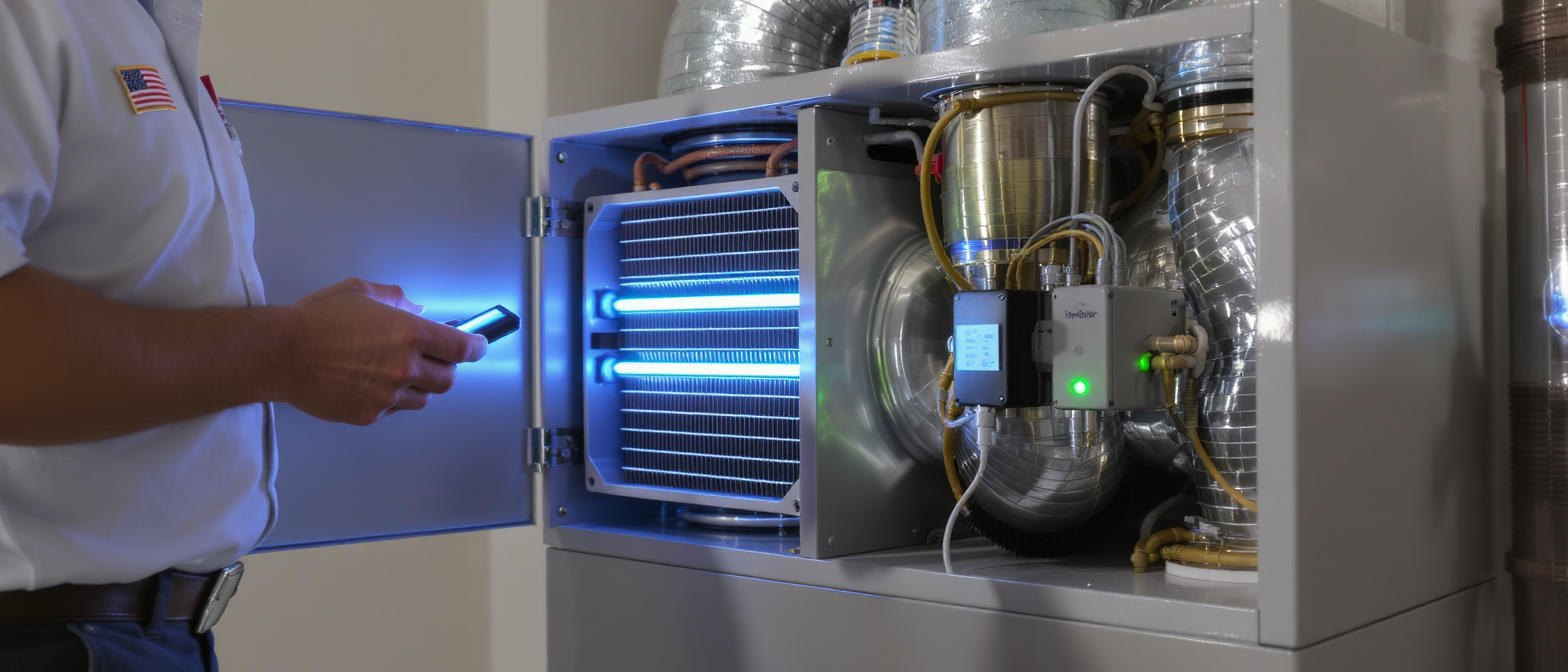
Searches for clean, healthy indoor air often lead to two add-ons: UV lights and ionizers for HVAC systems. Do they actually work? The short answer: UV-C can be effective in specific, well-designed applications, while ionizers show mixed real-world results. Neither replaces filtration and ventilation, and both require proper engineering, installation, and maintenance to be safe and beneficial.
What UV-C Does in HVAC
Germicidal UV-C light damages microorganisms’ DNA/RNA so they can’t replicate. Performance depends on wavelength (typically 254 nm), dose, distance, exposure time, lamp cleanliness, and air temperature/humidity. In HVAC, UV-C is used in two ways.
Two common UV applications
- Coil UV (surface irradiation): Lamps shine continuously on the evaporator coil and drain pan. This suppresses mold and biofilm, keeping coils cleaner, restoring heat-transfer efficiency, and helping maintain airflow. Evidence here is strong when lamps are correctly sized and maintained.
- In-duct air UV (airstream disinfection): Lamps are mounted in supply or return ducts to treat moving air. Effectiveness varies because air moves fast; microbes need sufficient dose, which requires careful lamp selection, placement, and sometimes multiple lamps or reflective duct surfaces.
What independent studies suggest
- Coil UV can reduce microbial growth and improve coil cleanliness and pressure drop, supporting system efficiency and indoor air quality (IAQ).
- Airstream UV can inactivate airborne pathogens, but performance is highly sensitive to lamp output, contact time, and maintenance. Results range from modest to significant when engineered properly.
- UV-C is not a substitute for filtration, ventilation, source control, or humidity management. It is a complement.
Ionizers: How They Work and What We Know
Ionizers, including bipolar ionization and needlepoint designs, release charged ions to make tiny particles cluster (agglomerate) so filters can catch them more easily, or to react with certain gases and microorganisms.
Potential benefits often cited
- May increase effective particle size, helping downstream filters capture more particles.
- May reduce some odors and volatile organic compounds under controlled conditions.
- Some systems claim very low energy use and easy retrofit.
Limitations and concerns
- Results vary widely across buildings. Benefits are inconsistent without strong airflow, proper filtration (ideally MERV 13 or higher), and verified ion density in the occupied zone.
- Some ionizers can generate ozone or byproducts if not designed or tuned correctly. Look for independent ozone-free verification (for example, certifications such as UL 2998) and review third-party performance data.
- Charged particles may plate out on surfaces, shifting rather than removing contaminants if filtration is weak.
- Marketing claims do not replace commissioning data. Require measured outcomes where possible.
Where These Devices Fit in the IAQ Toolbox
- Ventilation: Bring in and distribute enough outdoor air per code and good practice.
- Filtration: Use right-sized filters (MERV 13 or higher when the system can handle it) and maintain seals to prevent bypass.
- Humidity: Aim for roughly 30–50% RH to discourage mold and support comfort.
- Source control: Limit pollutant sources indoors and seal ducts to reduce infiltration.
- UV and ionization: Consider as targeted enhancements after the fundamentals are confirmed.
Safety and Compliance Basics
- UV-C can damage skin and eyes. Use proper shielding, interlocks, and access panels. Verify materials near lamps are UV-rated.
- Electrical work must meet code. Some jurisdictions and insurers require licensed installation and permits for in-duct devices.
- For ionizers, verify ozone-free claims and third-party test reports. Building owners and property managers may require documented compliance.
Cost of Ownership
- UV lamps degrade. Many need replacement every 9–24 months depending on lamp type and duty cycle.
- Keep lamps and quartz sleeves clean for consistent output; coil-side lamps often need periodic coil/fixture cleaning.
- Ionizers require cleaning and verification of output; some have replaceable elements.
- Budget for power draw, parts, and inspections; skipped maintenance quickly erodes benefits.
When UV or Ionizers Make Sense
- Persistent coil biofilm or mold issues: Coil UV is a proven solution that also helps efficiency.
- High-risk spaces or specific air quality targets: A properly engineered airstream UV system can add meaningful reduction of airborne microbes.
- Projects with strong filtration and good mixing: Ionizers may help particle capture when paired with MERV 13+ filters and verified performance.
- Wildfire smoke events: Prioritize filtration and building pressurization; UV/ionization play a secondary role.
Why Professional Assessment Matters
DIY installation can be unsafe: UV exposure risks, electrical hazards, and potential ozone creation are real. Undersized or misplaced devices can waste energy and money. Many insurance policies, property managers, and local authorities require licensed professionals to select, install, and document in-duct air-cleaning equipment, especially in commercial settings.
Our Engineering Perspective in Southern California
#1 AC Guys is a family-owned HVAC company serving Los Angeles County and nearby areas including Orange County, Ventura County, and Western Riverside County. We specialize in commercial and residential work, especially large and complex projects. Our mission is simple: healthy air at home for a healthy life.
We are a fourth-generation family of engineers with 80+ years of experience in engineering. Our engineers have completed factory training with Fujitsu (Japan), Mitsubishi Electric (Thailand), Midea (China), Gree (China), and Haier (China). This background supports careful system design, commissioning, and verification rather than one-size-fits-all add-ons.
Service areas include communities across the region such as Los Angeles, Pasadena, Glendale, Burbank, Long Beach, Santa Monica, Anaheim, Irvine, Santa Ana, Costa Mesa, Ventura, Thousand Oaks, Oxnard, Riverside, Corona, and Temecula.
Key Takeaways
- Do UV lights work? Yes, especially for coil disinfection; airstream UV can be effective when engineered for dose and contact time.
- Do ionizers work? Sometimes, but results vary; prioritize ozone-free models with independent test data and pair with strong filtration.
- Neither replaces ventilation, filtration, humidity control, and source control.
- Safety, codes, documentation, and maintenance matter—and are often required by insurers and building owners.
- For the best outcomes, evaluate the whole system and your building’s goals before adding devices.
Yasmine is currently an Associate Professor of Psychology at Mount Saint Mary College where she teaches a wide array of courses in the Psychology department. She is a Fulbright Scholar spent a year working at the Medical Decision Making Center at Ono Academic College in Israel.
Yet, as many higher education professionals can surely attest to, I have also witnessed the other challenge in group decision making. In academia, engaging in critical dissent is encouraged (reviewed by Jetten & Hornsey, 2014), and while this is a fine attribute, practically,

