


How to Reduce Noise from the Outdoor AC Unit
Why your outdoor AC unit gets loud
Your outdoor AC unit (the condenser) makes sound every time the fan and compressor run. Some noise is normal, but rattling, buzzing, humming, clanking, or screeching can point to vibration, airflow restriction, loose hardware, worn bearings, or electrical issues. Heat, sun exposure, and installation conditions in Southern California can amplify those sounds, especially on concrete pads and near reflective walls.
Below is a practical guide to reduce outdoor AC noise safely. Many fixes are straightforward maintenance steps; others involve refrigerant circuit, electrical components, or structural changes that should only be handled by a licensed HVAC professional. In fact, warranties, building codes, and insurance policies often require qualified service to keep coverage intact.
Quick checks you can safely do
- Power off first: Switch the unit off at the thermostat and the disconnect. Wait for the fan to stop before any touch.
- Clear airflow: Maintain 2–3 feet of open space around the unit and at least 5 feet above. Trim shrubs, remove leaves, and clear trash screens. Restricted airflow forces the fan and compressor to work harder and louder.
- Gentle coil rinse: With power off, rinse the outside coil fins from the inside out using low-pressure water. Never use a pressure washer.
- Level the base: If the pad has settled and the unit tilts, sound and vibration increase. Small composite shims under the pad corners can help. If the unit is heavily out of level, stop and call a pro—refrigerant oil return depends on proper leveling.
- Tighten exterior screws: With power off, lightly snug accessible top and grille screws. Do not open electrical compartments.
- Replace missing fan shroud screws or rubber feet on the base if they’re externally accessible; if not, have a technician install proper isolation mounts.
Noises you should not ignore
- Screeching or screaming: Possible high pressure or a failing bearing. Shut the system down and call a pro immediately.
- Hissing or bubbling: Potential refrigerant leak. Do not attempt DIY repairs—refrigerant handling requires EPA certification and improper work can void warranties and insurance claims.
- Rapid clicking or loud buzzing from the electrical side: Could be a failing contactor or capacitor. Electrical hazards are real here—bring in a licensed technician.
- Metallic clank or fan striking: A bent blade or loose motor mount can create dangerous vibrations.
Upgrades that quiet the condenser
- Vibration isolation pad: A dense, elastomer pad under the unit reduces structure-borne noise. In seismic areas, anchoring methods must meet local code.
- Rubber isolators for line sets: Where copper lines contact framing or stucco, add grommets or line set isolators to stop humming transfer into walls.
- Compressor sound blanket: Only use a manufacturer-approved sound blanket sized for your model. The wrong blanket can overheat the compressor. Insurers and warranties may require OEM-approved parts.
- Fan blade and motor balancing: A balanced fan reduces turbulent noise. This requires specialized tools and is not a DIY task.
- Variable-speed technology: Inverter-driven condensers and heat pumps run at lower speeds most of the time, dramatically cutting decibels. Modern variable-speed systems from brands such as Fujitsu, Mitsubishi Elektrik, Midea, Gree, and Hier are known for quieter operation when properly sized and installed.
Placement, barriers, and landscaping
- Respect clearances: Keep the unit a few feet away from bedroom windows and reflective walls. Angled placement can prevent sound from bouncing into living spaces.
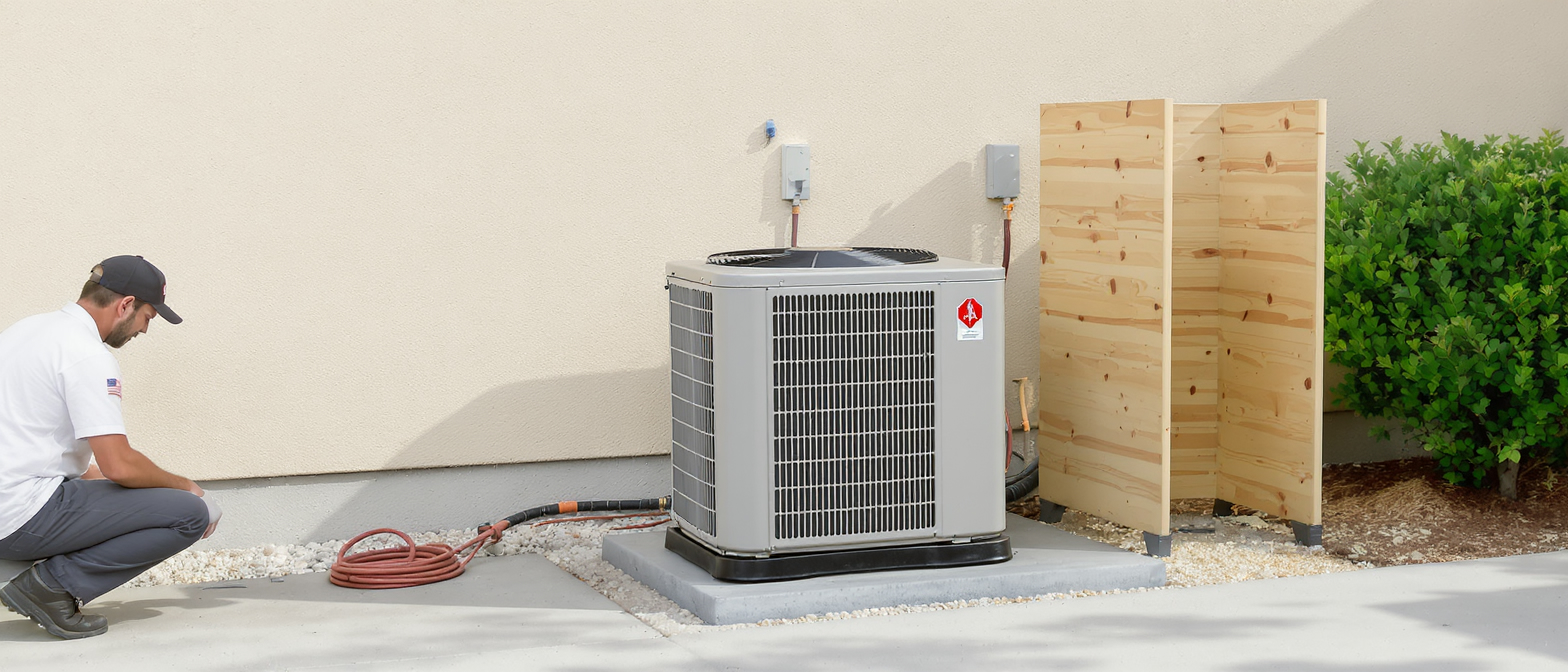
- Acoustic fence: Build a U-shaped sound fence with dense materials (e.g., wood with mass-loaded vinyl) at least 3 feet from the unit. The barrier should be higher than the top of the condenser but must not block service access or airflow.
- Soft landscaping: Plant dense shrubs a few feet out from the unit to absorb sound. Avoid blocking service panels and keep the 2–3 foot clearance.
- Relocation: Moving a condenser to a different side of the home can reduce perceived noise dramatically. This typically requires permits, electrical work, new line sets, and Title 24 compliance in California—hire a licensed HVAC contractor.
Maintenance that keeps noise down
- Clean coils annually: Clean coils lower pressure and compressor workload.
- Change indoor air filters: A clogged filter raises system pressure, making the outdoor unit louder.
- Check fasteners and isolation annually: Wind and thermal cycles loosen hardware and harden rubber feet over time.
- Correct charge and airflow: Low or high refrigerant charge, or improper airflow, forces the compressor to run harshly. Only an EPA-certified technician should adjust charge.
- Keep records: Many home insurance carriers and manufacturers ask for proof of professional maintenance to honor claims and warranties.
How quiet is realistic?
Typical modern condensers operate around 55–75 dB at 3–6 feet. Variable-speed inverter units often run below 55 dB on partial load. If your system is far above these ranges, inspection is wise. A small reduction of 3 dB equals about a 50% drop in perceived loudness; stacking improvements (isolation pad, line set isolators, acoustic fence) produces additive gains.
Safety and warranty reminders
- Do not open electrical compartments or sealed panels.
- Do not bend coil fins with sharp tools or use high-pressure washers.
- Do not add refrigerant, swap capacitors, or fit non-OEM parts yourself. DIY work can void equipment warranties and jeopardize insurance coverage.
Local context: Los Angeles and nearby counties
Neighborhood density in Los Angeles County, coastal humidity swings in Ventura County, hotter inland days in Western Riverside County, and HOA rules in parts of Orange County all affect how you approach outdoor AC noise reduction. Always check HOA guidelines and city permits when relocating equipment or adding sound fences. Cities we commonly serve include Los Angeles, Long Beach, Glendale, Pasadena, Burbank, Santa Monica, Anaheim, Irvine, Santa Ana, Fullerton, Huntington Beach, Ventura, Oxnard, Thousand Oaks, Riverside, Corona, and Temecula, among others.
When a professional is essential
If noise relates to refrigerant leaks, compressor health, electrical components, fan bearings, incorrect sizing, or relocation, a licensed HVAC technician should handle it. Many insurance carriers and manufacturers require qualified work to keep policies, SEER2 performance, and warranties valid. For large or complex homes and commercial facilities, engineered solutions—such as structural isolation, advanced inverter retrofits, or acoustic modeling—deliver the biggest and safest gains.
About #1 AC Guys
#1 AC Guys is a family HVAC company serving Los Angeles County and nearby areas, including Orange County, Ventura County, and Western Riverside County. We are a 4th-generation family of engineers with 80+ years of engineering experience. Our team is factory-trained at manufacturer facilities: Fujitsu (Japan), Mitsubishi Elektrik (Thailand), Midea (China), Gree (China), and Hier (China). We specialize in residential and commercial projects, especially large and complex designs, always guided by our mission: healthy air at home for a healthy life.
Key takeaways
- Start with safe basics: clear airflow, gentle coil rinse, level base, tighten exterior screws.
- Use isolation pads, line set grommets, and manufacturer-approved compressor sound blankets.
- Add acoustic barriers with proper clearances; consider relocation or variable-speed upgrades for major gains.
- Call a licensed pro for refrigerant, electrical, mechanical, or code-related work—often required by warranties and insurance.
Yasmine is currently an Associate Professor of Psychology at Mount Saint Mary College where she teaches a wide array of courses in the Psychology department. She is a Fulbright Scholar spent a year working at the Medical Decision Making Center at Ono Academic College in Israel.
Yet, as many higher education professionals can surely attest to, I have also witnessed the other challenge in group decision making. In academia, engaging in critical dissent is encouraged (reviewed by Jetten & Hornsey, 2014), and while this is a fine attribute, practically,

